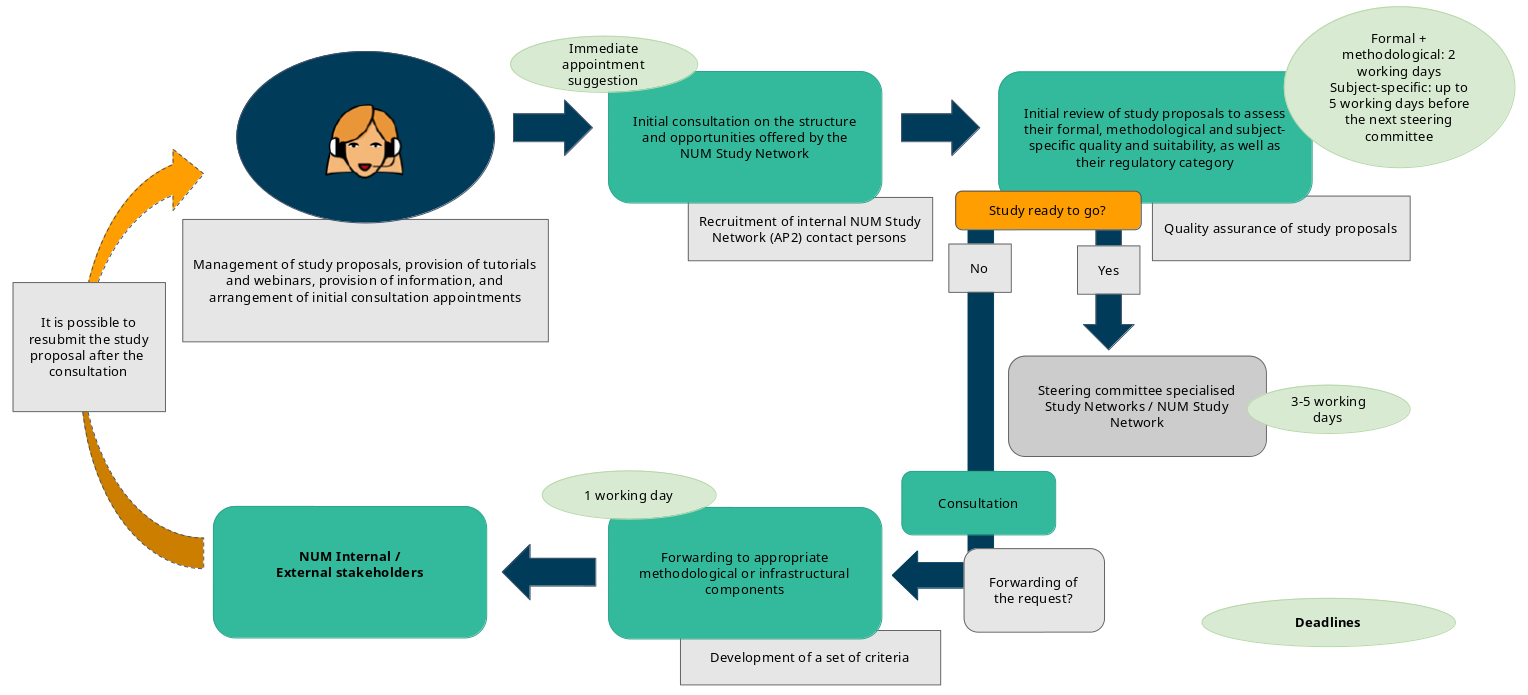
A standard intake process for new projects is initiated and tailored to the relevant funding program. During an initial free consultation, study proposal ideas are discussed, and feasibility of implementation within the NUM Study Network is assessed.
Our goal is to enable all projects to begin promptly and in a quality-assured manner. Once all the required documents have been submitted, they undergo formal, methodological, and subject-specific suitability checks.
If the project is ready for implementation, it is forwarded to the steering committee of the relevant specialty network. The committee then decides if the project can be carried out within the network. If further preparation is required, a consultation session is offered to clarify support needs and identify appropriate infrastructures.
This process includes feedback loops that allow you to adjust or resubmit your study proposal within the NUM Study Network.
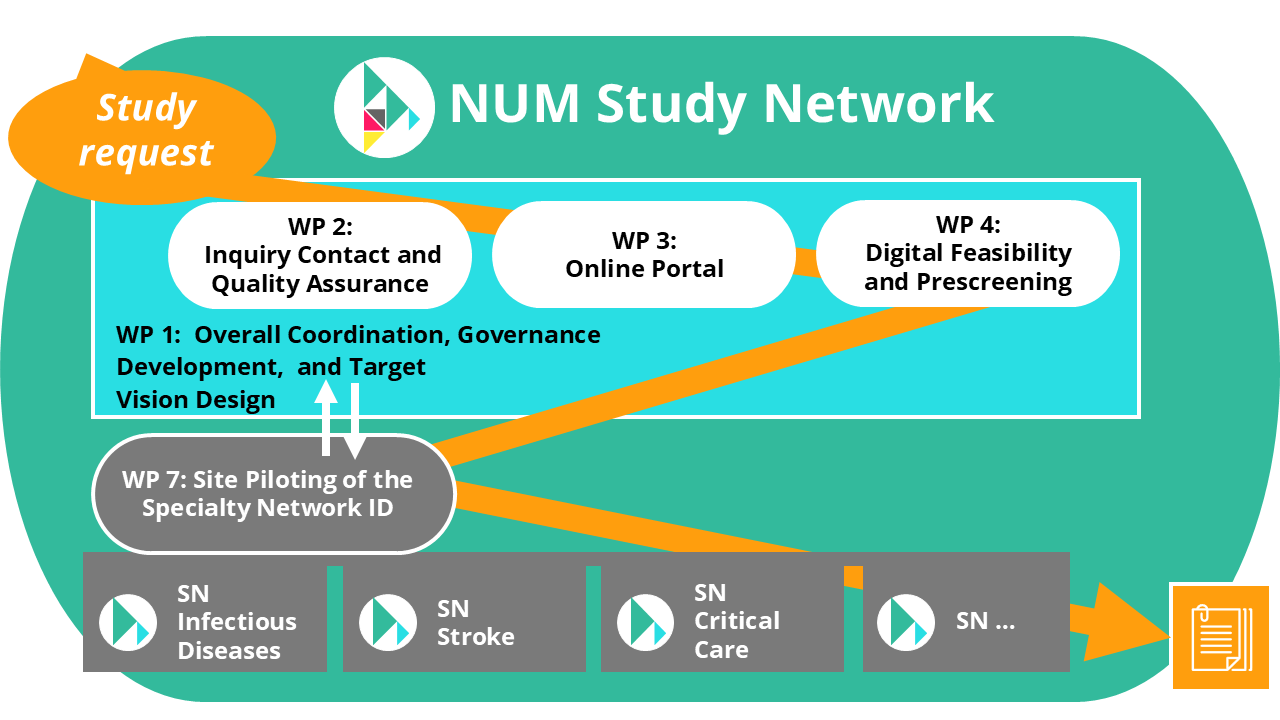
The study proposal then proceeds to WP 3, where it is integrated into an online portal that centralizes coordination and communication across participating institutions. In parallel, WP 4 handles digital feasibility and prescreening, using digital tools to assess potential study sites and participant eligibility, thereby ensuring that studies are effectively matched with sites that are suitable for their study design.
All of these steps are overseen by WP 1, which is responsible for overall coordination, governance development, and the designing a target vision for the network. This foundational work package ensures that each study is aligned with the strategic objectives and operational standards of the NUM Study Network.
Completion of these preparatory stages marks the transition ofthe study into WP 7, which covers the pilot implementation at selected sites (“Standort-Pilotierung des Fachnetzwerks”). This stage involves testing and validating the workflow, infrastructure, and readiness of individual centers within the expert networks.
The study is subsequently conducted within one or more specialty networks, depending on its focus area. These include the Specialty Network Infectious Diseases, Stroke, or Critical Care. These thematic networks enable tailored support and expertise, ensuring that the study meets the highest possible clinical and scientific standards.
Once data the data has been collected and the results are analyzed, the findings are disseminated through publications in peer-reviewed journals, thus closing the study lifecycle with scientific impact and public visibility.